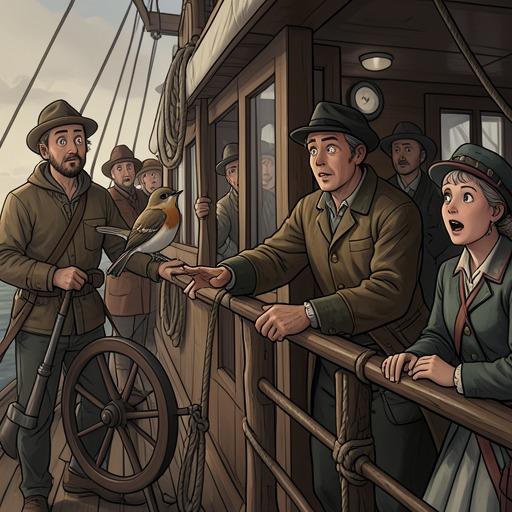
Messenger from land
The Emigrants“Messenger from land” is the name the emigrants give the small, unidentified bird that appears aboard the Charlotta far out at sea. More than a visitor, it becomes a shared sign of the home and living world they have left behind: its arrival briefly makes land imaginable again, while its departure leaves the passengers without that comfort and is followed by another storm.
Appearance and Arrival
The bird is tiny, with a blue-black head and tail, green wings and back, and a white throat and breast. No passenger or crew member can identify its kind. Some guess that it is a wader or a kind of swallow; others speculate that it might be a young seabird. Its pointed beak and quick movements offer clues, but no settled name. Its silence adds to the mystery: it does not sing, and the passengers wonder whether its inability to make a sound has some explanation.
The emigrants had seen seagulls earlier in the crossing, but those companions have disappeared. Now, hundreds of miles from the nearest land, a small bird suddenly makes itself at home on deck. The passengers read its arrival not as an ordinary encounter with wildlife but as a miracle, a messenger sent from land. Their interpretation grows out of the long absence of other living creatures and the ship’s distance from any shore: the bird seems to have crossed an impossible stretch of ocean to reach them.
A Shared Sign of Home
The bird’s importance lies less in what the emigrants can know about it than in what it allows them to remember. Its green and white coloring connects it, in their imagination, to birch leaves and marsh flowers, to forests, fields, and the ground where life takes root. After many days without standing on firm earth, they see in this small creature evidence that land still exists. It brings the world of growing things into the ship’s enclosed, unstable world.
That reminder is communal. The passengers feed the bird with crumbs of bread and ship’s biscuits, and the crew also looks after it. A sailmaker makes it a soft nest from pieces of wadmal behind the sail near the mainmast. During the day it moves about the deck; at night it shelters near the mast. Passengers follow its movements and take pleasure in its presence. Its brief stay gives them something to attend to together and recalls the trees, flowering fields, and spring woods that belong to a life beyond the ship.
The bird is also understood through stories and beliefs the emigrants bring with them. Some imagine it to be enchanted, perhaps a king or prince concealed in feathers; they treat it with a mixture of awe and apprehension, hoping it will bring a blessing but wondering whether it might also bring harm. The sailors notice that the wind has favored the vessel since the bird arrived and are especially careful not to injure it. Such interpretations do not resolve the bird’s identity. They show how the isolation of the crossing turns an unfamiliar visitor into a focus for hope, speculation, and shared attention.
Departure and Loss
The passengers hope the bird will remain for the rest of the crossing, but one morning it is gone. The ship is searched without finding a feather or other trace. The emigrants conclude that it has left rather than died, and they do not doubt that it can reach land, whatever the distance or weather. The bird’s unexplained arrival is matched by an equally unexplained departure; the passengers cannot learn where it came from or what it intended to tell them.
Its loss is felt as the loss of one of their own. For days, sorrow remains aboard, and the emigrants wonder why the messenger did not stay to witness the fulfillment of the hope it seemed to announce. The bird had made the passengers’ remembered homeland feel close enough to visit their ship; without it, they once again have nothing aboard to remind them of the green earth. Experienced sailors regard its departure as an evil omen, and another storm breaks the following day. The sequence deepens the bird’s significance without explaining it: a moment of reassurance gives way to absence, uncertainty, and renewed exposure to the sea.
Narrative Significance
The episode sets the migrating passengers’ imagined relation to land against the physical fact of their isolation at sea. The bird does not tell them where they are going, identify their destination, or guarantee a safe crossing. Instead, it makes the existence of land tangible for a few days. Its presence gathers the emigrants’ longing into an ordinary, fragile creature; their care for it turns that longing into a shared practice rather than a private thought.
The episode also gives the crossing a rhythm of arrival and loss. The bird appears without explanation, becomes a source of companionship and wonder, and disappears before the passengers can understand its meaning. Its departure cannot be confirmed as a bad omen, though the sailors’ concern and the storm that follows make the association difficult to ignore. The messenger offers no answer to the emigrants’ questions. Its lasting effect is the memory of a brief encounter that affirmed another world existed beyond the ship, then left them to continue across the ocean without it.